Student accommodation in Brighton and Hove
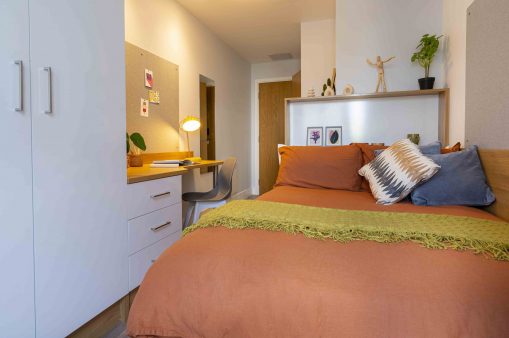
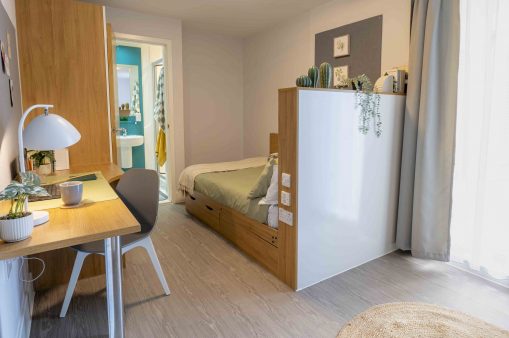
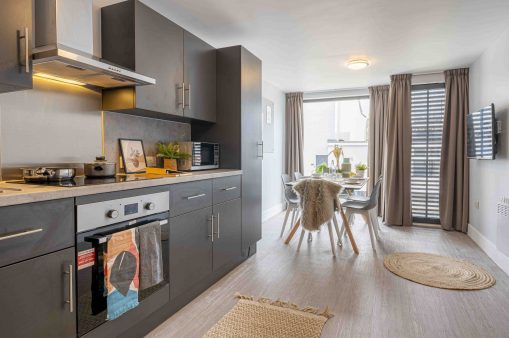
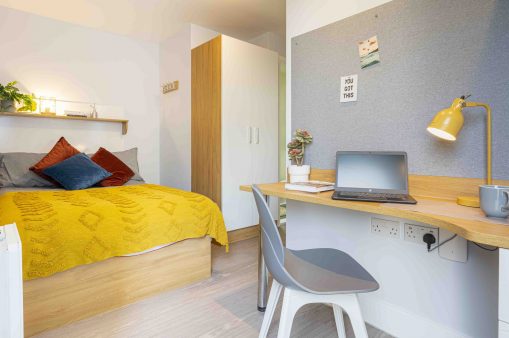
Student accommodation in Brighton and Hove is concentrated along the Lewes Road corridor that runs north from the city centre towards Moulsecoomb and Falmer, with further options in the city centre itself. Most include bills in the weekly rent and offer facilities such as gyms, study spaces, communal lounges and bike storage. Where you choose to live will depend on which university you are attending, whether you want to be in the thick of the city or closer to a campus, and your budget.
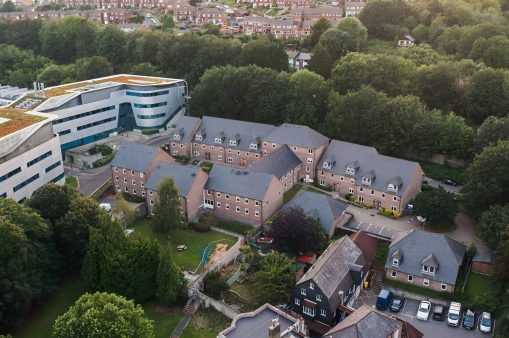
For students at the University of Brighton’s Moulsecoomb Campus or the University of Sussex at Falmer, the Lewes Road area is a popular choice. Moulsecoomb Place is one of the most affordable options on the page, with townhouse-style flats shared between eight to ten flatmates starting from £169.00 per week. It is a two-minute walk from Moulsecoomb railway station and the University of Brighton’s Moulsecoomb Campus, with a Sainsbury’s and an Aldi within walking distance and the University of Sussex roughly two miles away by bus.
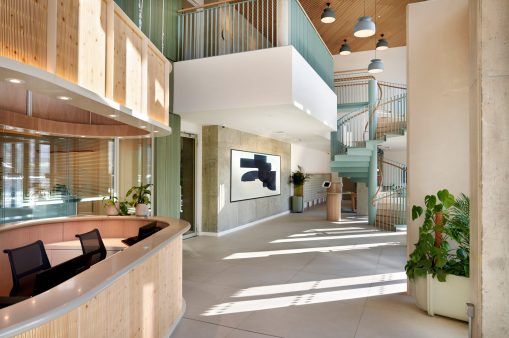
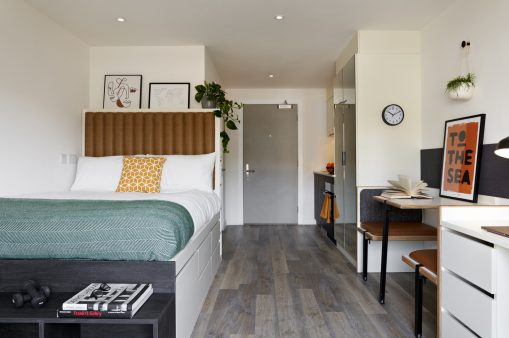
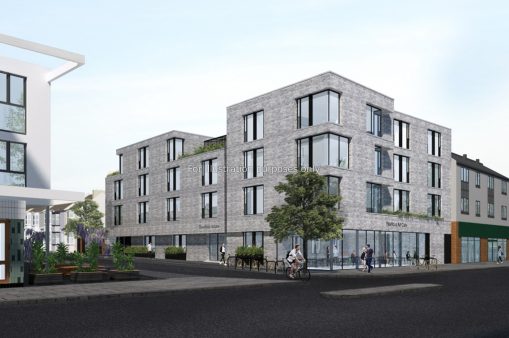
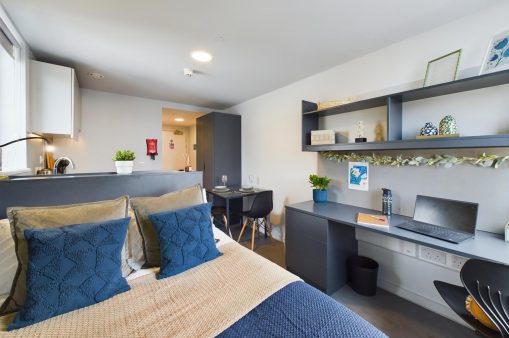
Also on Lewes Road, Student Castle Brighton offers studios and twin rooms within walking distance of the University of Brighton’s School of Business and Law and the International College. The building has a 24/7 gym, cinema room, games lounge, two roof terraces and free bike hire, with rooms starting from £279.00 per week. Moulsecoomb station is roughly ten minutes away on foot, and trains take about four minutes to reach Brighton main station.
Ravilious House is a little further down Lewes Road in the Round Hill area, offering en-suite rooms and self-contained studios starting from £249.00 per week. It is roughly twenty minutes’ walk to the University of Brighton’s Grand Parade campus and to Brighton Museum & Art Gallery, with the seafront within walking distance. The setback roof garden, cinema room, private study rooms and on-site gym make it a strong option for students looking for more facilities at the premium end.
For students wanting to live closer to the city centre rather than the campus belt, iQ Abacus House is on Baker Street, just off London Road. It offers en-suite rooms and studios starting from £199.00 per week and is approximately ten minutes’ walk from the University of Brighton’s City Campus at Grand Parade, with London Road station seven minutes away on foot. The Open Market bus stop a few minutes from the door has direct services to the University of Sussex at Falmer.
Brighton is among the more expensive student cities in the UK outside London, with most rooms falling between £180 and £300 per week. Use the filters on Mystudenthalls.com to narrow your search by price, room type and distance from your university.
Brighton and Hove at a glance
Brighton and Hove is a unitary authority on the south coast of England with a population of approximately 278,000 (ONS mid-2022 estimate), and it has held city status since 2000. The economy is built on creative, digital and tech industries, tourism and hospitality, finance, and higher education, with a well-known cluster of tech and media businesses around Wired Sussex. With over 37,700 students living in the city, roughly 11% of the population is in higher or further education, giving it a young and visibly creative character.
The city is home to two universities and several specialist providers. The University of Brighton has roughly 17,000 students across three Brighton campuses: City (Grand Parade), Moulsecoomb (its largest), and Falmer. Its Eastbourne campus closed in 2024. The University of Sussex has approximately 20,000 students at its parkland campus in Falmer, on the city’s north-eastern edge inside the South Downs National Park. The Brighton and Sussex Medical School is jointly run by both universities and has been training doctors since 2003. BIMM University, founded in Brighton in 2001 and granted full university status in 2022, specialises in music, performing arts and screen, with notable alumni including James Bay, George Ezra and Tom Odell. The Greater Brighton Metropolitan College, Varndean College and a number of language schools also bring large student communities to the city.
There is a lot to see and do. The Royal Pavilion is George IV’s seaside palace, an Indo-Saracenic confection that has been the city’s most photographed building since the 1820s. The Lanes is the original old town, now a maze of narrow alleys filled with jewellers, vintage shops and independent cafés, and the North Laine just to the north is the city’s bohemian shopping district with around 400 independent businesses. Brighton Palace Pier, opened in 1899 and Grade II*-listed, remains the city’s most visited free attraction. SEA LIFE Brighton, opened in 1872 and designed by the seaside engineer Eugenius Birch, is widely described as the world’s oldest continually operating aquarium. After financial difficulties and administration proceedings in 2024, the i360 continued operating under new management arrangements in 2025.
Sport matters here. Brighton & Hove Albion play Premier League football at the Amex Stadium in Falmer, sitting directly between the University of Sussex and the University of Brighton’s Falmer site, and a five-minute walk from Falmer station. Sussex County Cricket Club has played at the 1st Central County Ground in Hove since 1872, making it one of the oldest first-class cricket grounds in England.
Brighton has one of the strongest cultural calendars of any English city outside London. The Brighton Festival in May is one of England’s largest curated annual arts festivals, running alongside the Brighton Fringe, the country’s biggest fringe arts festival. The Great Escape, also in May, is one of Europe’s leading new music industry events, with hundreds of emerging acts playing across small venues throughout the city. Brighton & Hove Pride at the start of August is the UK’s biggest Pride festival, drawing approximately half a million visitors across the weekend. The Brighton Dome on Church Street hosts year-round concerts and is best known internationally as the venue where ABBA won Eurovision in 1974 with Waterloo.
For green space, the South Downs National Park starts at the city’s northern edge and includes Stanmer Park, which adjoins the University of Sussex campus and is a popular spot for picnics and walks. Closer to the centre, Preston Park is the largest urban park in the city, hosting Pride in the Park each August. Queen’s Park lies between Kemptown and Hanover, and Wild Park at the back of Moulsecoomb is a 100-acre Local Nature Reserve. The Seven Sisters chalk cliffs are roughly an hour away by bus or train and one of the most photographed stretches of the English coast.
Getting around Brighton and Hove
Brighton and Hove is a compact city, with the seafront, main shopping districts and university campuses all within roughly three miles of each other. The city lies in a valley between the South Downs and the sea, so some areas like Hanover and Elm Grove involve steep climbs, but most journeys are manageable on foot, by bus or by bike.
By bus
Brighton & Hove Buses is the main operator and runs the most frequent network in the city, with single fares capped at £3 across all routes until at least March 2027. The most useful routes for students are the 25 between the city centre and Falmer (serving both the University of Sussex and the University of Brighton’s Falmer site), the 28 Regency Route up Lewes Road, and the 49 across the north of the city. From autumn 2025 the city operates a discounted student citySAVER, with day tickets at £4 and a weekly ticket at £15 for students who verify their university or college ID through the Brighton & Hove Buses app. Metrobus and Stagecoach South operate selected additional routes, and tickets are interchangeable on most journeys within the citySAVER zone.
By train
Brighton main railway station is one of the busiest stations on the south coast, with direct services to London Victoria from roughly 52 minutes and London Bridge via Thameslink, Gatwick Airport in approximately 30 minutes, and routes along the south coast to Portsmouth, Southampton, Eastbourne, Hastings and Ashford International. Local stations matter for students too: Moulsecoomb station is two minutes from the University of Brighton’s Moulsecoomb Campus, Falmer station serves the University of Sussex and the Amex Stadium, and London Road station is the closest to the Lewes Road and Round Hill student areas. Preston Park and Hove stations cover the western and northern residential neighbourhoods.
By bike
The city’s hire scheme is BTN BikeShare, operated by Beryl in partnership with Brighton & Hove City Council, with stations across the city centre, along the seafront and at the universities. The Lewes Road cycle corridor is one of the longest segregated cycle routes outside London and connects the city centre to both universities. The seafront cycle path runs the full length of the city from Hove to the Marina.
Brighton does not have a tram, underground or other mass transit system, so buses and trains are the main options for journeys beyond walking or cycling distance.
Student areas in Brighton and Hove
Moulsecoomb
Moulsecoomb is the heart of the student belt and home to the University of Brighton’s largest campus. A quiet, suburban area on Lewes Road roughly two miles north of the city centre, it is well connected by the 25 and 49 buses and by its own railway station with direct trains to Brighton main station in four minutes. It is the most popular area for first-year University of Brighton students and remains busy through second and third year thanks to the cluster of student accommodation along Lewes Road. Sainsbury’s, Aldi and a row of independent cafés and takeaways line the road, and Wild Park lies behind the campus.
Falmer
Falmer lies at the north-eastern edge of the city, on the South Downs side, and is home to the University of Sussex’s parkland campus as well as part of the University of Brighton’s Falmer site. The Amex Stadium stands between the two campuses, with Falmer station providing direct trains into Brighton in roughly eight minutes. It is quieter than the central student areas, with most social life happening on campus, but the setting inside the South Downs appeals to students who enjoy easy access to green space and walking routes.
Lewes Road
Lewes Road is the spine that connects the city centre to Moulsecoomb and on to Falmer, and is where most of Brighton’s student accommodation is concentrated. The 25 bus runs along its full length every few minutes and continues to the University of Sussex, and the segregated cycle corridor makes it one of the easiest routes for cycling between the city centre and the universities. The road is lined with cafés, supermarkets, takeaways, charity shops and the Open Market, a covered market with independent food and craft stalls.
Hanover
Hanover lies on the hillside east of The Level, made up of steep terraced streets sometimes called “Muesli Mountain” for its concentration of independent cafés and pubs. It is popular with second and third year students who want a quieter, more residential setting close to the city centre. The walk down to the city centre takes roughly ten minutes; the walk back up is slower. The Greys, the Geese and the Constant Service are all classic Hanover pubs.
Kemptown
Kemptown stretches east from the Royal Pavilion along the seafront and is the LGBTQ+ heart of the city, with a strong concentration of bars, independent shops, vintage stores and cafés. It lies close to the Royal Sussex County Hospital and is approximately fifteen minutes’ walk from the University of Brighton’s Grand Parade campus. Rents tend to be higher than further out, but you are walking distance to both the beach and the city centre nightlife.
City Centre
The city centre, covering the Old Town, The Lanes and North Laine, is the most expensive area for student accommodation but offers the shortest walks to bars, restaurants, shops and Brighton main station. It is roughly fifteen minutes’ walk to the University of Brighton’s Grand Parade campus and a bus ride to Moulsecoomb or Falmer. Studios and en-suite rooms in modern developments dominate the central accommodation market.
Hove
Hove lies west of Brighton and is technically a separate town, though the two have shared a unitary authority since 1997. It is quieter than central Brighton, with a longer, less busy stretch of seafront, the famous beach huts at the Hove Lawns, and a more residential character. It is popular with postgraduate and mature students, with rents typically slightly lower than Brighton city centre. Hove station has direct trains to both Brighton (six minutes) and London Victoria (under an hour).
Hollingdean
Hollingdean lies on a hill between Lewes Road and Preston Park, popular with University of Brighton students who want a quieter residential area close to the Moulsecoomb Campus. The bus into the city centre takes roughly fifteen minutes, and the walk down to Lewes Road takes about ten.
Student life in Brighton and Hove
Brighton has one of the most active student social scenes in the country. The nightlife is spread across the city centre, the seafront and the student areas to the east, and there is something happening most nights of the week.
In the city centre, North Laine and The Lanes form the main bar and music circuit. Komedia on Gardner Street is one of the best comedy clubs outside London and hosts regular live music. The Green Door Store, tucked under the arches at Brighton station, is a free-entry live music venue with a strong rotation of new bands. Chalk on Pool Valley (formerly The Haunt) hosts indie and electronic touring acts. The Hope and Ruin on Queens Road is another reliable spot for live music in an intimate room above a pub.
Along the seafront, Concorde 2 on Madeira Drive is one of the country’s best-loved independent music venues, hosting club nights and gigs in a converted Victorian tea-room. Patterns nearby splits its programme between live music downstairs and club nights upstairs, with sea views from the terrace. Volks Club, just under the arches, is a long-standing venue for drum & bass, dubstep and underground electronic music. Revenge on Old Steine is the city’s longest-running LGBTQ+ club.
Brighton’s music heritage runs deep. Fatboy Slim (Norman Cook) has lived in the city for decades and his Big Beach Boutique parties on Brighton beach in the early 2000s remain some of the largest free events the country has ever hosted. The Brighton Dome hosted ABBA’s Eurovision win in 1974, and the city has produced or adopted everyone from The Levellers to Royal Blood to Rizzle Kicks. BIMM University’s presence means there is a steady supply of new bands playing the smaller venues.
Beyond nightlife, Brighton has one of the strongest independent food scenes in the UK. It is often described as one of the country’s leading vegan-friendly cities, with a notably high concentration of plant-based restaurants per head. The Open Market on London Road is good for cheap lunches, and the streets around North Laine offer everything from street food to Sri Lankan to Modern British. The city’s festival calendar means the May Brighton Festival and Brighton Fringe, the May music industry showcase The Great Escape, and Brighton & Hove Pride in early August are all key dates in the student social calendar.
Brighton also has a strong record on student safety. Many venues operate the Ask for Angela scheme, where you can discreetly signal to staff that you feel unsafe, and the city is part of the Safe Space Sussex partnership which runs across the night-time economy. The Royal Sussex County Hospital in Kemptown has a 24-hour A&E.
Student accommodation in Brighton FAQs
Is Brighton expensive for students?
Brighton is among the more expensive student cities in the UK outside London. Most student rooms fall between £180 and £300 per week, with shared houses on Lewes Road typically starting from £140 to £160 per week and city centre studios going up to £300 or more. The cost of living overall falls below London but above the UK average. If you need any guidance on financing student accommodation, our guide on how students pay for accommodation is a good starting point.
How do students get around Brighton?
Most students walk or cycle for short journeys, with the city compact enough that the seafront, city centre and Lewes Road area are all within about a mile of each other. For longer journeys, Brighton & Hove Buses runs the main network with single fares capped at £3 and a student citySAVER offering all-day travel for £4 or a week for £15. The 25 bus runs from the city centre to Falmer and serves both universities. Brighton main station has direct trains to London Victoria from 52 minutes and Gatwick Airport in approximately 30 minutes.
What universities are in Brighton?
Brighton and Hove is home to the University of Brighton (approximately 17,000 students), the University of Sussex (roughly 20,000 students at Falmer), the Brighton and Sussex Medical School (a joint partnership between the two universities), and BIMM University, which specialises in music, performing arts and screen. The Greater Brighton Metropolitan College and Varndean College serve large further education communities, and several language schools also operate in the city.
Is Brighton good for students?
Brighton is one of the highest-ranked UK student cities in the QS Best Student Cities index, drawing students for its independent culture, music and nightlife scenes, year-round festival calendar and seaside setting. Roughly 11% of the city’s population is in higher or further education, which makes student life visible across the city rather than confined to a single campus area.
How do I book student accommodation in Brighton?
You can browse all available student accommodation in Brighton and Hove on Mystudenthalls.com, compare prices and features, and contact providers directly through the listing pages. Many properties offer online viewings or virtual tours if you are unable to visit in person.
When should I start looking for student accommodation in Brighton?
Most providers open bookings for the following September from October or November, and January and February are particularly busy as more students receive university offers. Starting early gives you the widest choice, especially for the cheaper shared flats, which go first.
Where are the cheapest areas to live in Brighton?
Moulsecoomb and the Lewes Road corridor are the cheapest areas for private rooms, followed by Hollingdean, Hanover and Hove. The city centre carries the highest rents. Filtering by weekly price and looking at shared flats rather than studios is the quickest way to find cheap student accommodation in Brighton.
How big a deposit can a Brighton provider ask for?
Under the Tenant Fees Act 2019, a security deposit is capped at five weeks’ rent where the annual rent is under £50,000, and any holding deposit to reserve a room is capped at one week’s rent. Anything above those limits is not allowed.
Do I need a guarantor, and what if I am an international student?
Many providers ask for a UK-based guarantor who agrees to pay your rent if you cannot. International students who cannot provide one may be able to use a paid guarantor service such as Housing Hand, or pay rent in larger instalments where the provider allows it. The Mystudenthalls.com guide on how students pay for accommodation covers the options.
Which areas suit University of Sussex and University of Brighton students?
For the University of Sussex at Falmer, look at Falmer itself for campus proximity or Moulsecoomb, Lewes Road and the city centre for a mix of city life and a quick train or bus in. For the University of Brighton, Moulsecoomb is closest to the main campus, while the centre and London Road suit the City campus at Grand Parade.