Greater London is divided into 32 boroughs, each with its own council, plus the City of London, which is a separate local authority. Your borough’s council handles your council tax and your voter registration, and you have to live in one of the boroughs of London during term time to get an 18+ Student Oyster photocard from Transport for London (TfL).
What is a London borough?
A London borough is a local authority area with its own elected council. Each London borough council runs local services in its area, bills council tax and keeps the electoral register.
The Mayor of London and the Greater London Authority (GLA) deal with matters that cover the whole city. Their London Plan sets planning policy for all of Greater London, and the boroughs work within it.
Many boroughs share a name with a neighbourhood inside them, and the borough is the larger area. The London Government Act 1963 formed the borough of Hackney from three older councils, Hackney, Shoreditch and Stoke Newington, so the borough takes in far more than the neighbourhood of the same name. Camden and Greenwich work the same way.
How many boroughs are there in London?
There are 32 boroughs in London, plus the City of London, which makes 33 local authority areas in all. The boroughs were created by the 1963 Act and came into being on 1 April 1965. The government’s list of councils in England still counts 32 London boroughs plus the City of London.
London boroughs map
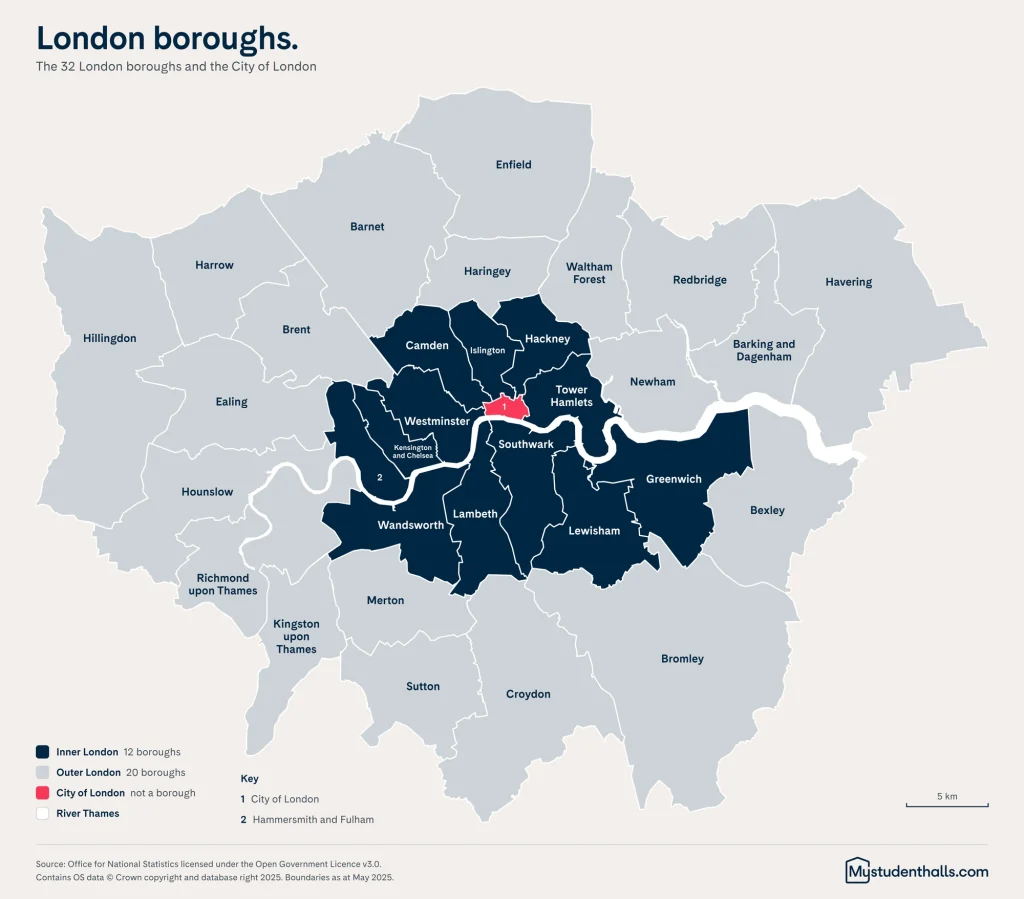
The 12 Inner London boroughs, in the darker shade, sit around the City of London on both banks of the River Thames, and the 20 Outer London boroughs surround them. London borough boundaries decide which council an address belongs to, and they do not follow postcodes or fare zones. The outlines are from the Office for National Statistics (ONS).
List of London boroughs
All 32 boroughs and the City of London are listed here in alphabetical order, with ONS figures for population, area and rent.
| Borough | Inner or outer | Population | Area (sq km) | One-bed rent a month |
|---|---|---|---|---|
| Barking and Dagenham | Outer | 238,295 | 36.1 | £1,380 |
| Barnet | Outer | 408,087 | 86.8 | £1,506 |
| Bexley | Outer | 257,103 | 60.6 | £1,235 |
| Brent | Outer | 352,201 | 43.2 | £1,579 |
| Bromley | Outer | 336,048 | 150.1 | £1,328 |
| Camden | Inner | 216,658 | 21.8 | £2,069 |
| City of London | Neither | 15,631 | 2.9 | No figure |
| Croydon | Outer | 410,085 | 86.5 | £1,273 |
| Ealing | Outer | 387,072 | 55.5 | £1,644 |
| Enfield | Outer | 329,400 | 80.8 | £1,429 |
| Greenwich | Inner | 301,225 | 47.3 | £1,568 |
| Hackney | Inner | 266,241 | 19.0 | £2,015 |
| Hammersmith and Fulham | Inner | 190,216 | 16.4 | £2,037 |
| Haringey | Outer | 266,218 | 29.6 | £1,651 |
| Harrow | Outer | 272,612 | 50.5 | £1,395 |
| Havering | Outer | 280,787 | 112.3 | £1,221 |
| Hillingdon | Outer | 326,671 | 115.7 | £1,270 |
| Hounslow | Outer | 299,486 | 56.0 | £1,593 |
| Islington | Inner | 224,551 | 14.9 | £2,196 |
| Kensington and Chelsea | Inner | 145,734 | 12.1 | £2,691 |
| Kingston upon Thames | Outer | 172,761 | 37.3 | £1,394 |
| Lambeth | Inner | 314,298 | 26.8 | £1,905 |
| Lewisham | Inner | 301,037 | 35.1 | £1,462 |
| Merton | Outer | 218,891 | 37.6 | £1,653 |
| Newham | Outer | 376,542 | 36.2 | £1,639 |
| Redbridge | Outer | 321,829 | 56.4 | £1,381 |
| Richmond upon Thames | Outer | 196,713 | 57.4 | £1,755 |
| Southwark | Inner | 312,366 | 28.9 | £1,923 |
| Sutton | Outer | 213,972 | 43.8 | £1,256 |
| Tower Hamlets | Inner | 334,240 | 19.8 | £2,005 |
| Waltham Forest | Outer | 283,713 | 38.8 | £1,421 |
| Wandsworth | Inner | 339,859 | 34.3 | £1,950 |
| Westminster | Inner | 212,367 | 21.5 | £2,563 |
Inner or outer follows the London Government Act 1963, and the City of London is neither because it is not a borough. Population is the Office for National Statistics’ mid-2025 estimate. Area is its land area measurement for December 2024. Rent is its average monthly private rent for a one-bedroom home in October 2026, and it publishes no figure for the City of London.
In October 2026 the ONS average private rent for a one-bedroom home ran from £1,221 a month in Havering to £2,691 in Kensington and Chelsea, and was £1,774 for London as a whole. These are rents for whole homes let privately. They show how the boroughs compare with each other, but a student room is priced differently. Our guide to how much student accommodation costs covers room prices.
Inner and outer London boroughs
Under the 1963 Act, which the list above follows, the boroughs numbered 1 to 12 in its first schedule are Inner London boroughs and the other 20 are Outer London boroughs. The City of London is in neither group because it is not a borough.
Two other definitions are in wide use. The GLA’s London Plan 2021 lists 14 areas as inner, adding Newham and the City of London to the Act’s 12, and 19 as outer. The ONS uses another grouping for its regional statistics, with Haringey and Newham in Inner London and Greenwich in Outer London. A page that gives 13 inner boroughs, or 14 with the City of London, is using one of these two lists.
Boroughs in central, north, east, south and west London
No single official map splits London into north, south, east and west. One official grouping is the five sub-regions the GLA drew up for its London Plan consultation in 2009, published on the London Datastore:
- Central: Camden, the City of London, Islington, Kensington and Chelsea, Lambeth, Southwark and Westminster.
- East: Barking and Dagenham, Bexley, Greenwich, Hackney, Havering, Lewisham, Newham, Redbridge, Tower Hamlets and Waltham Forest.
- North: Barnet, Enfield and Haringey.
- South: Bromley, Croydon, Kingston upon Thames, Merton, Richmond upon Thames, Sutton and Wandsworth.
- West: Brent, Ealing, Hammersmith and Fulham, Harrow, Hillingdon and Hounslow.
Earlier versions of the London Plan grouped some boroughs differently, so older documents may not match this list.
London universities by borough
The table gives the borough of each campus and the fare zone of its nearest stations, for 22 universities. It is not a list of every site, and some universities also teach in other boroughs. Check the campus as well as the university, because King’s College London alone has campuses in Westminster, Lambeth and Southwark.
| Borough | University and campus | Station zone |
|---|---|---|
| Barnet | Middlesex UniversityHendon | 3/4 |
| Brent | University of WestminsterHarrow | 4 |
| Camden | Birkbeck, University of LondonBloomsbury | 1 |
| Camden | SOAS University of LondonBloomsbury | 1 |
| Camden | University College LondonBloomsbury | 1 |
| Camden | University of the Arts LondonCentral Saint Martins, King’s Cross | 1 |
| Ealing | University of West LondonEaling | 3 |
| Greenwich | University of GreenwichGreenwich | 2/3 |
| Greenwich | University of GreenwichAvery Hill | 4 |
| Hammersmith and Fulham | Imperial College LondonWhite City | 2 |
| Hillingdon | Brunel University of LondonUxbridge | 6 |
| Islington | City St George’s, University of LondonClerkenwell | 1 |
| Islington | London Metropolitan UniversityHolloway | 2 |
| Kingston upon Thames | Kingston UniversityPenrhyn Road | 6 |
| Lambeth | King’s College LondonWaterloo and St Thomas’ | 1 |
| Lewisham | Goldsmiths, University of LondonNew Cross | 2 |
| Newham | University College LondonUCL East | 2/3 |
| Newham | University of East LondonDocklands | 3 |
| Newham | University of East LondonStratford | 2/3 |
| Newham | University of the Arts LondonLondon College of Fashion, Stratford | 2/3 |
| Richmond upon Thames | St Mary’s University, TwickenhamStrawberry Hill | 5 |
| Southwark | King’s College LondonGuy’s | 1 |
| Southwark | King’s College LondonDenmark Hill | 2 |
| Southwark | London South Bank UniversitySouthwark | 1/2 |
| Southwark | University of the Arts LondonLondon College of Communication, Elephant & Castle | 1/2 |
| Tower Hamlets | Queen Mary University of LondonMile End and Whitechapel | 2 |
| Wandsworth | City St George’s, University of LondonTooting | 3 |
| Wandsworth | University of RoehamptonRoehampton | 3 |
| Westminster | Imperial College LondonSouth Kensington | 1 |
| Westminster | King’s College LondonStrand | 1 |
| Westminster | London School of Economics and Political ScienceHolborn | 1 |
| Westminster | University of WestminsterRegent Street and Marylebone | 1 |
| Outside Greater London | Royal Holloway, University of LondonEgham, Surrey | No zone |
The zone is the fare zone of the stations nearest each campus. King’s College London’s Denmark Hill campus is split between Southwark and Lambeth, and Imperial College London’s South Kensington campus runs into Kensington and Chelsea.
Six boroughs have two or more of these universities. To compare rooms near any of these campuses, see student accommodation in London.
Camden
Camden takes in Bloomsbury, King’s Cross and Hampstead. Birkbeck, SOAS University of London and University College London all teach in Bloomsbury, and the University of the Arts London has Central Saint Martins at King’s Cross. All four campuses are by zone 1 stations.
Islington
Two of these universities have a campus in Islington. City St George’s, University of London is in Clerkenwell, in zone 1, and London Metropolitan University is on Holloway Road, in zone 2.
Newham
Three of these universities have campuses in Newham. University College London’s UCL East campus and the University of the Arts London’s London College of Fashion are both on the Queen Elizabeth Olympic Park in Stratford, and the University of East London has a Stratford campus of its own. All three are in zone 2/3. The University of East London’s Docklands campus is in zone 3.
Southwark
London South Bank University and the University of the Arts London’s London College of Communication are both at Elephant & Castle, in zone 1/2. King’s College London has two campuses in Southwark, Guy’s by London Bridge in zone 1 and Denmark Hill in zone 2.
Wandsworth
The two campuses listed for Wandsworth are served by zone 3 stations. The University of Roehampton is in Roehampton, and City St George’s, University of London has a campus in Tooting.
Westminster
Four of the universities have a campus in Westminster, the same number as Camden. King’s College London’s Strand campus and the London School of Economics and Political Science are both here, and so is the University of Westminster at Regent Street and Marylebone. Imperial College London’s South Kensington campus has its main address in Westminster, but the campus runs over the borough boundary and its Sir Alexander Fleming Building is in Kensington and Chelsea. All of them are in zone 1.
Other boroughs with university campuses
Eleven more boroughs have one of the universities each. In Inner London, Goldsmiths, University of London is in Lewisham, Queen Mary University of London is in Tower Hamlets and the University of Greenwich is in Greenwich. Imperial College London’s White City campus is in Hammersmith and Fulham, and King’s College London’s Waterloo and St Thomas’ campuses are in Lambeth.
In Outer London, Brunel University of London is in Hillingdon, Kingston University is in Kingston upon Thames, Middlesex University is in Barnet, St Mary’s University, Twickenham is in Richmond upon Thames and the University of West London is in Ealing. The University of Westminster’s Harrow campus is in Brent, although its postal address says Harrow.
Royal Holloway, University of London has its main campus at Egham in Surrey, outside Greater London and outside the fare zones. It also teaches in Bloomsbury, so check where your course is based.
What your borough means for you as a student
Council tax is set and billed borough by borough. GOV.UK says households where everyone is a full-time student do not have to pay it, and that you can apply for an exemption if you do get a bill. The application goes to the council for the borough you live in, which will want proof that you are a student, such as a certificate from your university or college. Our guide to whether students pay council tax covers the rules in more detail.
TfL’s 18+ Student Oyster photocard takes 30% off adult-rate Travelcards and Bus & Tram Pass season tickets. It does not cut pay as you go fares on its own. One of its conditions is that you live in a London borough during term time, and the application asks for a London borough address. A student whose term-time address is outside Greater London does not meet that condition, wherever the university is. If it is the other way round, and you live in a London borough but study outside Greater London, TfL says to check whether your university is registered on the scheme.
You register to vote with the council for the borough you live in. A student with a home address and a term-time address may be able to register at both, as long as the two are not in the same council area.
Boroughs, areas, postcodes and zones: how they differ
- Borough. A council area with fixed boundaries. The borough bills council tax for an address and keeps its entry on the electoral register.
- Area or neighbourhood. Names such as Shoreditch, Brixton and Bloomsbury are informal and have no council of their own. The same goes for the districts and towns London grew from.
- Postcode district. NW1, SE1 and E1 belong to Royal Mail’s addressing system and can cross borough boundaries. On King’s College London’s Denmark Hill campus, one SE5 postcode is in Southwark and another is in Lambeth.
- Fare zone. Zones are TfL’s and belong to stations, so one borough can have stations in more than one zone. In Greenwich, the University of Greenwich’s Greenwich campus is by zone 2/3 stations and its Avery Hill campus is in zone 4. Our guide to London zones has the zone of each campus and what travel costs.
Sources
- Legislation and London government: the London Government Act 1963, the government’s list of councils in England, the Greater London Authority’s London Plan 2021, Annex 2 and the London Datastore’s sub-regions, for the number of boroughs, how they were formed, Inner and Outer London and the sub-regions.
- Office for National Statistics: mid-2025 population estimates, Standard Area Measurements, private rents to October 2026 and its statistical areas, for the table’s figures, the map boundaries and its version of Inner London.
- Transport for London: the 18+ Student Oyster photocard page, for the discount and the London borough condition.
- GOV.UK and the borough councils: council tax for full-time students, Find your local council, Haringey Council on council tax for students and voting from two addresses, Kingston Council and Royal Greenwich, for council tax, voting and royal status.
- The universities’ own sites and Office for National Statistics postcode and boundary data, for the borough of each campus.
Figures come from the sources named above and can change.
London boroughs FAQs
Is the City of London a borough?
No. The City of London is a separate local authority run by the City of London Corporation, and the government’s list of councils in England counts it apart from the 32 London boroughs. It is still part of Greater London, and the GLA puts it in the Central sub-region with six boroughs.
Why does London have 32 boroughs?
Because the London Government Act 1963 created 32, each by merging older councils. Westminster, for example, joined the older boroughs of Westminster, Paddington and St Marylebone, and Enfield joined Edmonton, Enfield and Southgate.
What is the biggest borough in London?
Bromley is the biggest by area, at 150.1 square kilometres in the ONS area measurements for December 2024. Croydon has the most people, with 410,085 in the ONS mid-2025 estimates, just ahead of Barnet with 408,087. Kensington and Chelsea is the smallest borough on both counts, at 12.1 square kilometres and 145,734 people.
Which London boroughs are royal boroughs?
Three hold the title, Kensington and Chelsea, Kingston upon Thames and Greenwich. Greenwich is the newest, having become the Royal Borough of Greenwich on 3 February 2012. Kensington and Chelsea and Greenwich are Inner London boroughs, and Kingston upon Thames is an Outer London borough.
Is Croydon a London borough?
Yes. Croydon is one of the 20 Outer London boroughs, formed under the 1963 Act from the county borough of Croydon and the urban district of Coulsdon and Purley. Kingston upon Thames, Bromley and Sutton are Outer London boroughs too.
Which London borough am I in?
Enter your postcode in GOV.UK’s “Find your local council” service and it names the council for that address. Your council tax bill names it as well. The town in a postal address can mislead, because an address can carry the name of one borough and sit in another.
Can I vote in two London boroughs as a student?
In borough council elections you can, if your home and term-time addresses are in two different boroughs and you are registered at both. In a general election, or in the Mayor of London and London Assembly elections, you can vote in one place only, and you choose which.